
Chiller Maintenance: Five Checks That Prevent Summer Breakdowns
Most chiller failures are predictable. Condenser condition, refrigerant charge, water quality, pump and controls — what to check and how often.

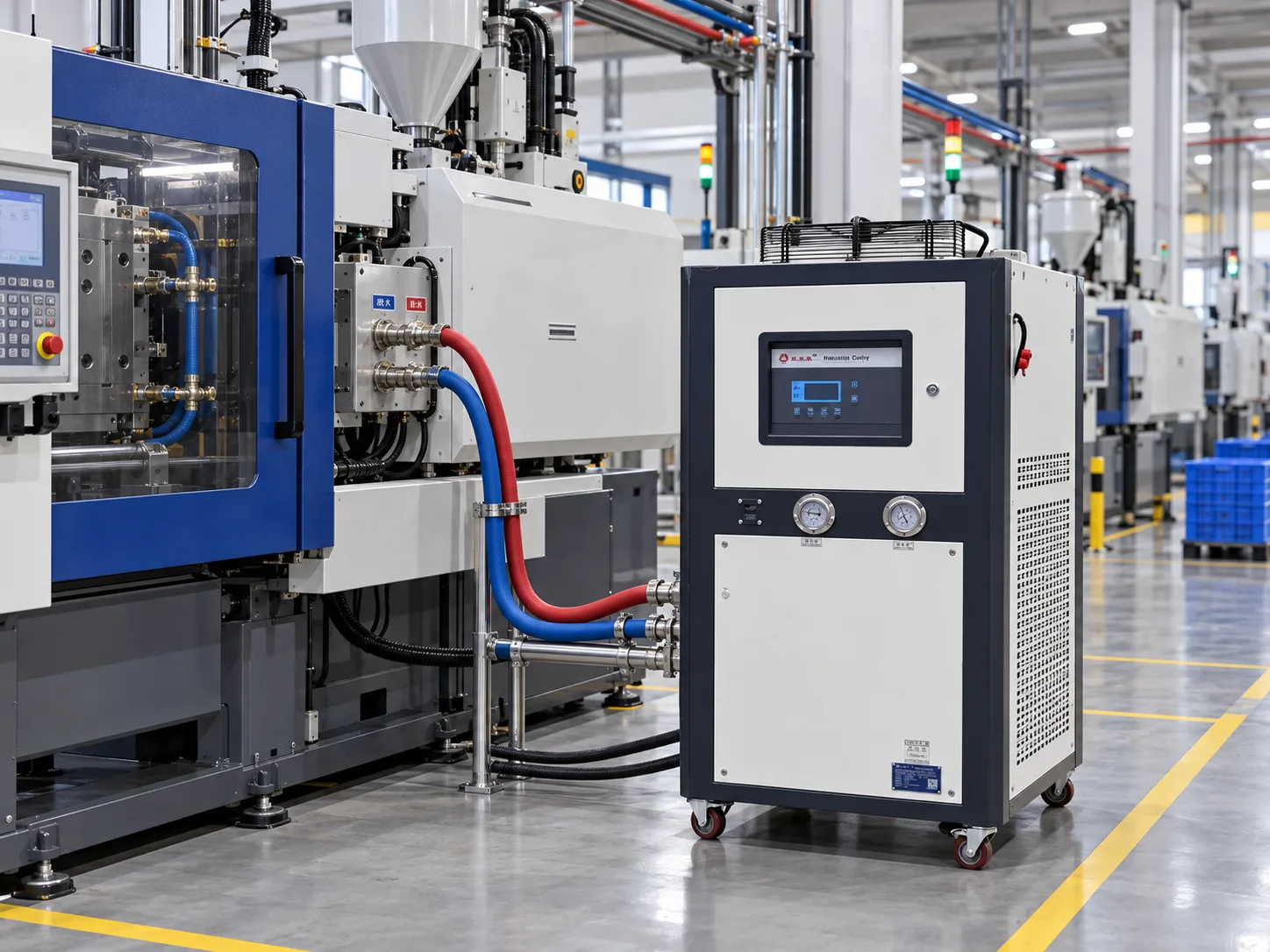
Chiller failures cluster in the first hot weeks of summer, and almost all of them are predictable. Five checks, done before the season starts, prevent the majority: condenser cleanliness, refrigerant charge, water quality, pump condition and control calibration.
None of them takes long. What they prevent is a plant losing cooling capacity on the day the ambient temperature peaks — which is also the day every machine runs at maximum load.
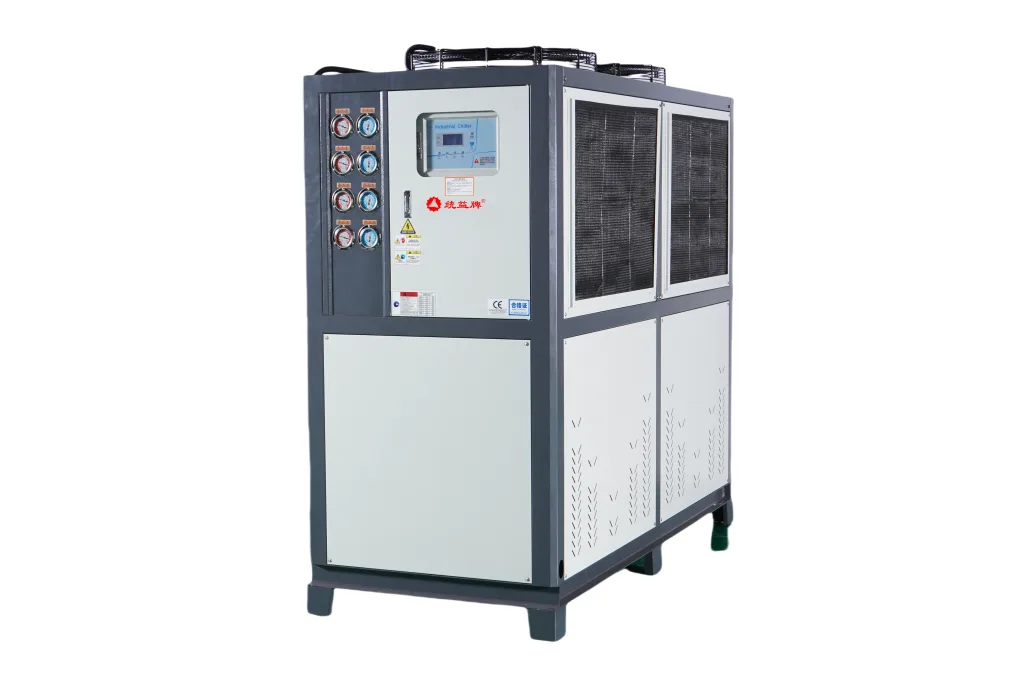
1. Condenser cleanliness
A fouled air-cooled condenser raises condensing temperature, which reduces capacity and increases compressor power at the same time. In a dusty molding hall, coils can lose a measurable share of capacity within a season.
Check: inspect the coil against a light source; clean with low-pressure air or water from the inside out; confirm no fins are bent or missing. Frequency: before summer and monthly during it in dusty environments.
2. Refrigerant charge and pressures
Low charge shows up as reduced capacity and elevated suction superheat, not as an obvious fault. A slow leak can run for a season before anyone notices the chiller is working harder for less cooling.
Check: record suction and discharge pressures at a known water temperature and load; compare with the commissioning values. A trend matters more than a single reading. Frequency: quarterly, and immediately if capacity drops.
3. Water quality in the chilled loop
Chilled water carries the heat from the molds, and what is in that water ends up in the evaporator and the mold channels. Scale insulates, biological growth fouls, and debris blocks small mold passages — all of which reduce heat transfer exactly where it matters.
| Parameter | Target | Failure if ignored |
|---|---|---|
| Conductivity | low, monitored | scale and corrosion |
| pH | 7–9 | corrosion of copper and steel |
| Suspended solids | filtered | blocked mold channels |
| Biological growth | absent | fouling, odour, reduced flow |
Check: sample the loop, inspect strainers, replace filters. Frequency: quarterly, with a filter change more often in new installations where construction debris is still flushing out.
4. Pump and flow
Flow loss looks like a cooling problem but is a pump problem. Worn impellers, blocked strainers and closed valves all reduce flow, and because mold temperature controllers compensate by opening valves further, the symptom appears as unstable mold temperature rather than low flow.
Check: measure pressure differential across the pump and compare with commissioning data; clean strainers; confirm valve positions. Frequency: quarterly, and whenever mold temperature becomes unstable.
5. Control calibration
A chiller that reads 12 °C while supplying 15 °C will run the compressor harder forever without reaching set point. Sensor drift is common and invisible without a reference measurement.
Check: compare the controller reading against an independent thermometer at the supply line; recalibrate if the offset exceeds about 1 °C. Frequency: annually, plus after any sensor replacement.
What should be logged?
A one-page log per chiller, filled monthly, catches degradation before it becomes a breakdown: supply and return temperature at a known load, suction and discharge pressure, pump differential, ambient temperature and any alarm history. The trend is the diagnostic; a single reading rarely is.
Where to go next
Both chiller types need the same discipline. The air-cooled chiller adds coil cleaning to the routine, while the water-cooled chiller adds cooling tower and water treatment. Where mold temperature stability is the visible symptom, check the mold temperature controller loop as well before assuming the chiller is at fault.
Tell us your chiller model and site conditions and our engineers will send a maintenance schedule matched to your environment.