
Hopper Dryer vs Desiccant Dryer: When Is the Upgrade Worth It?
A hopper dryer heats; a desiccant dryer controls dew point. Here is the resin list that decides which one you actually need, and when the upgrade pays back.

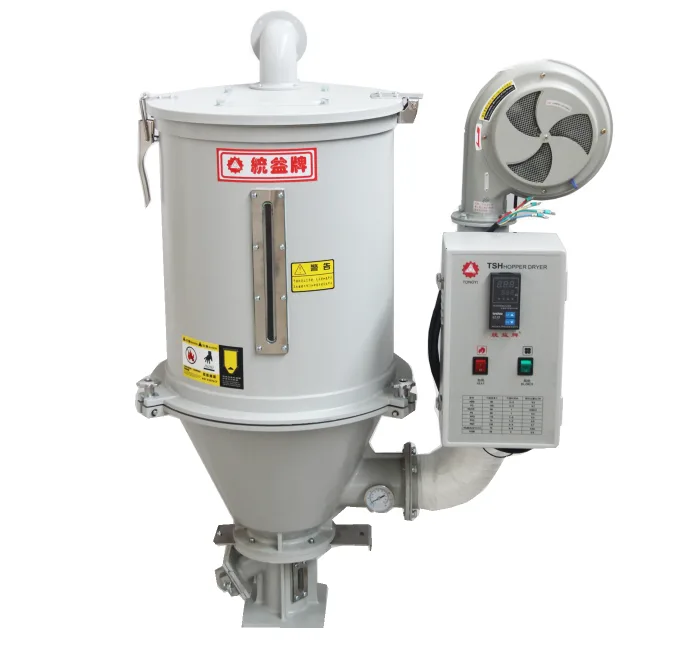
A hopper dryer heats air; a desiccant dryer controls the water content of that air. That single difference decides which resins can be dried at all. If you process ABS, PMMA or POM, a heated hopper is enough. If you process PA, PC, PET or PBT, a heated hopper cannot dry the resin no matter how long you leave it running, because the air it circulates is already loaded with ambient moisture.
The practical test is not the price difference — it is whether your target moisture content is below what ambient air can reach.
What is the actual difference between heated air and dried air?
Heated ambient air at 30 °C and 60 % relative humidity contains roughly 16 g of water per kilogram of dry air. Heating it to 100 °C lowers the relative humidity to about 2 %, but the absolute water content is unchanged — the dryer has simply made the same water vapour less saturated. When that air passes over cold granule, the granule still sees a moisture gradient that stops it from drying below roughly 0.15–0.20 %.
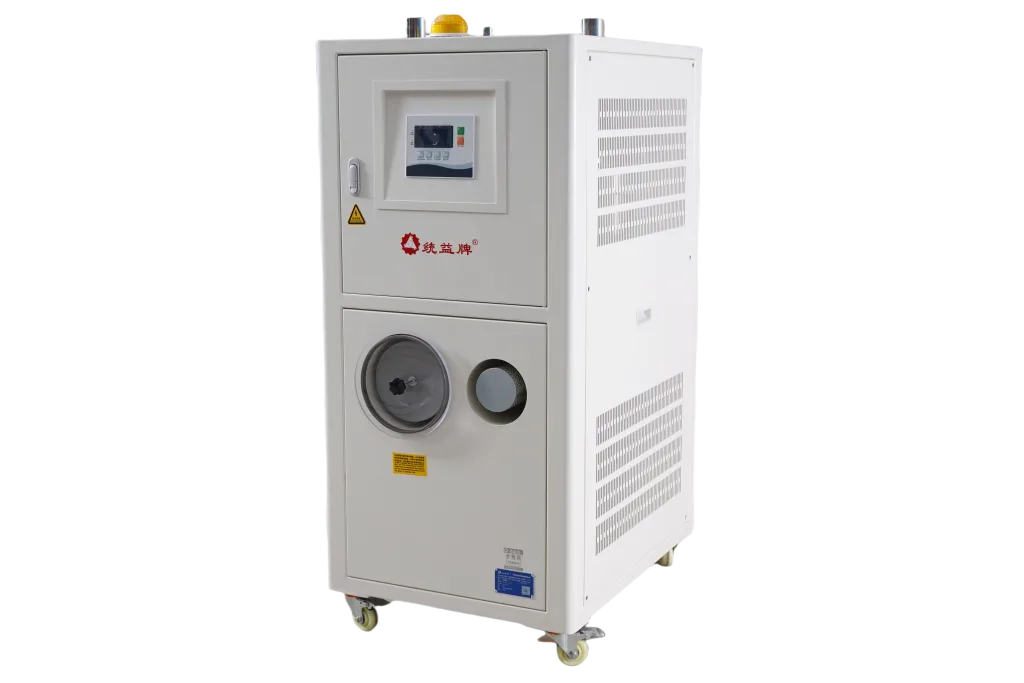
A desiccant rotor removes the water instead of hiding it. Air passes through a honeycomb wheel coated with silica gel or molecular sieve, which adsorbs moisture and delivers air at −20 °C or −40 °C dew point. That air can pull PA6 down to 0.05 % and PET down to 0.005 %, which heated ambient air cannot do at any temperature.
Which resins force the upgrade?
The dividing line is whether your target moisture is achievable with ambient air. In practice that puts most engineering resins on the desiccant side.
| Resin | Heated hopper enough? | Desiccant needed | Target moisture |
|---|---|---|---|
| PP, PE, PS | Yes — usually no drying at all | No | not critical |
| ABS, PMMA, POM | Yes | No | 0.05–0.10 % |
| PA6, PA66 | No | Yes, −20 °C | < 0.10 % |
| PC | No | Yes, −20 °C | < 0.02 % |
| PBT | No | Yes, −20 °C | < 0.04 % |
| PET | No | Yes, −40 °C | < 0.005 % |
When does the upgrade pay back?
The payback is not in energy saved — a desiccant dryer uses more. It is in scrap avoided. Three cost lines move together:
- Reject rate. A plant running 5 % rejects on PA parts from moisture splay typically drops to 1–2 % after switching to dew-point controlled drying. On a machine producing €400/h of parts, three points of scrap is €12/h.
- Material cost. Hydrolysed PA and PC cannot be re-used; the whole shot becomes scrap rather than regrind.
- Customer claims. Brittle parts that pass visual inspection and fail in service are the most expensive failure mode because they are found late.
A single desiccant dryer serving four machines typically pays back inside a year on those three lines alone, provided the reject rate was genuinely moisture-driven. That is the condition worth verifying first — drying will not fix a mold or cooling problem.
What does the rotor cost to run and maintain?
Two costs matter and both are predictable. Regeneration energy is the first: the rotor has to be heated to drive off the adsorbed water, which typically adds 15–25 % to the dryer’s total power draw. Rotor replacement is the second: a honeycomb wheel normally lasts three to five years depending on dust loading, and it is a consumable, not a lifetime part.
Dust is the variable you control. Return air filtration protects the rotor, and a clogged filter shows up as a slow dew point drift that nobody notices until parts fail. Checking and replacing the return-air filter on a fixed interval is cheaper than any rotor.
Can you run one dryer for several machines?
Yes, and it is usually the better economics once you have more than two or three machines on hygroscopic resin. A central desiccant dryer with a distribution manifold serves several machines from one rotor, which improves both capital efficiency and dew point consistency.
The constraint is residence time, not machine count. Each machine needs its own hopper holding enough material for the full drying time, so the dryer is sized on total throughput times drying hours, not on the number of connections.
What should you check before buying either?
Three questions separate a correct decision from an expensive one:
- What is the resin supplier’s target moisture? If it is below 0.10 %, ambient air cannot get there.
- How is moisture verified today? Without a measurement method, the upgrade cannot be justified or disproved.
- What is the real reject rate and its cause? Drying fixes moisture splay; it does not fix short shots, warpage or cold slugs.
Where to go next
The hopper dryer remains the right choice for ABS, PMMA, POM and short runs on non-critical resins. When the resin list includes PA, PC, PET or PBT, the honeycomb rotor dehumidifier is the minimum specification, and the three-in-one unit adds conveying when the line also needs material transport.
Send us your resin list, machine count and current reject rate and our engineers will tell you whether drying or something else is the limiting factor.