
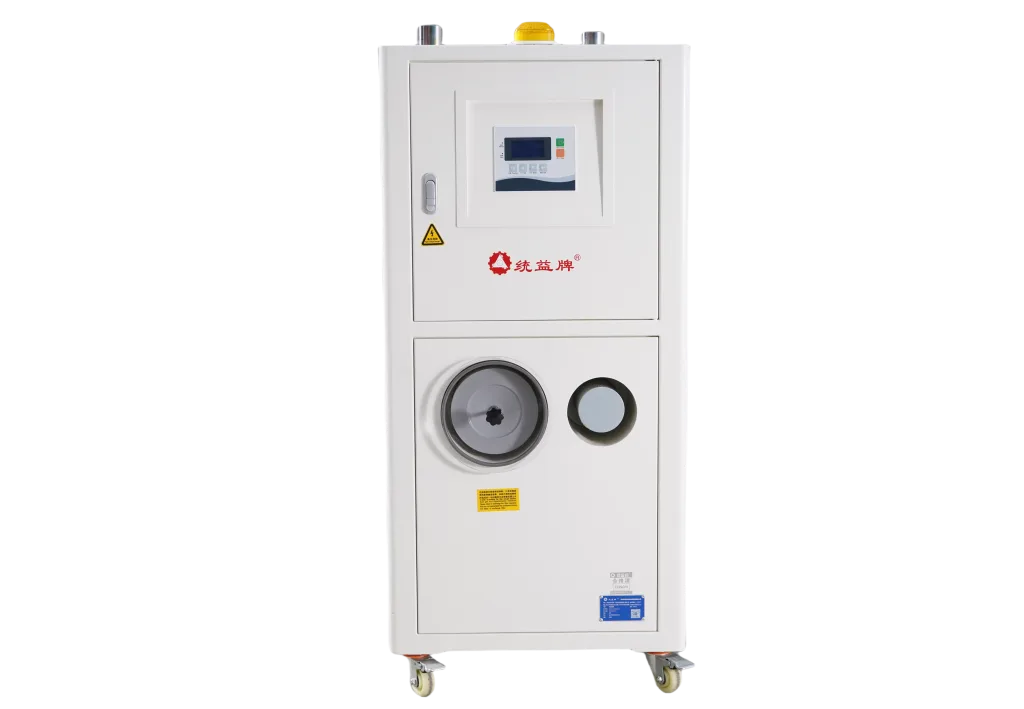
Honeycomb Rotor Dehumidifier
Honeycomb rotor dehumidifier designed to work with hopper dryers for stable low-dew-point drying of hygroscopic engineering plastics.
- Applicable Materials
- PET / PBT / PA / PC
- Dehumidifying Air Capacity
- 60–1500 m³/h
- Models Available
- 11
- Power Supply
- 3P 380VAC 50Hz
Core Advantages
Reliable Dehumidification with Lower Operating Costs
Stable Drying Performance
Stable low-dew-point dry air and precise temperature control help maintain consistent material drying conditions.
Lower Energy Consumption
The silica-gel honeycomb rotor operates at a regeneration temperature of approximately 150°C, reducing regeneration energy demand.
Easy Maintenance
Detachable stainless-steel cooler construction and a compact, user-friendly design simplify cleaning and routine maintenance.
Enhanced Operational Safety
Multiple protection devices, fault indication and intelligent alarms help reduce risks caused by machine or operating faults.
Key Features
Key Design Features
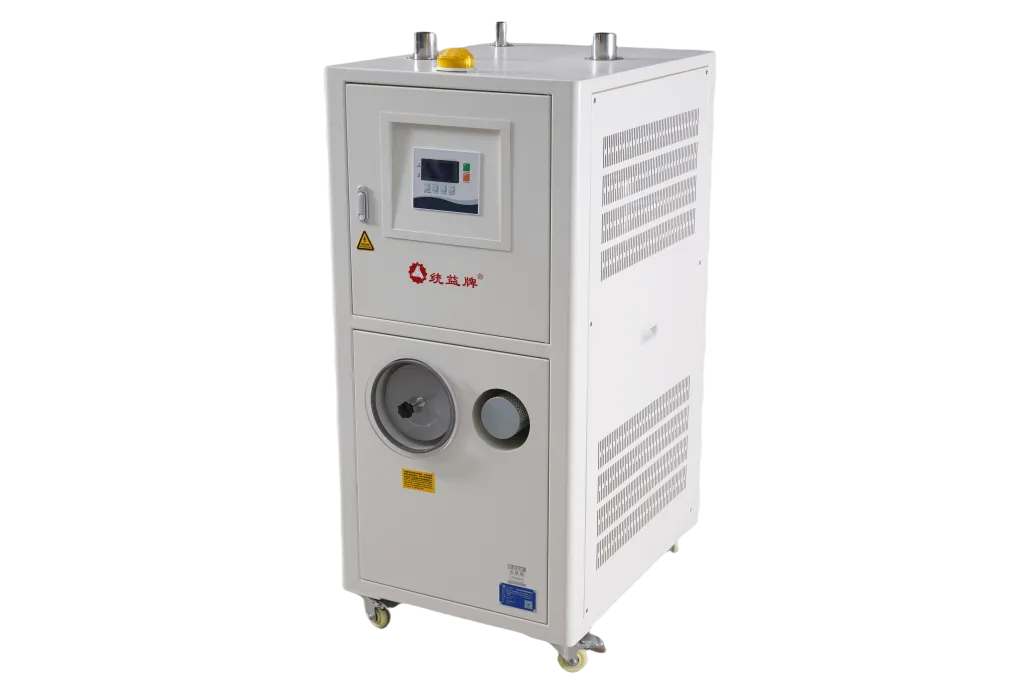
Technical Specifications
Technical Specifications
| Specification | TCD -60 | TCD-90 | TCD-120 | TCD-150 | TCD-200 | TCD-300 | TCD-400 | TCD-500 | TCD-800 | TCD-1000 | TCD-1500 |
|---|---|---|---|---|---|---|---|---|---|---|---|
| Dehumidifying Air Capacity (m³/h) | 60 | 90 | 120 | 150 | 200 | 300 | 400 | 500 | 800 | 1000 | 1500 |
| Dehumidifying Blower Power (50Hz)(kW) | 0.4 | 0.85 | 0.85 | 1.3 | 2.2 | 3 | 3 | 4 | 7.5 | 12.5 | 15 |
| Dehumidifying Blower Power (60Hz)(kW) | 0.5 | 0.95 | 0.95 | 1.5 | 2.55 | 3.45 | 3.45 | 4.6 | 8.6 | 14.5 | 17.2 |
| Regeneration Blower - 50HZ (KW)) | 0.2 | 0.4 | 0.4 | 0.4 | 0.4 | 0.4 | 0.7 | 0.7 | 0.85 | 1.3 | 1.6 |
| Regeneration Blower - 60HZ (KW)) | 0.23 | 0.5 | 0.5 | 0.5 | 0.5 | 0.5 | 0.83 | 0.83 | 0.95 | 1.5 | 2.1 |
| Regeneration Heater Power - 50HZ (KW)) | 3.8 | 3.8 | 3.8 | 3.8 | 7.4 | 7.4 | 7.4 | 7.4 | 11 | 16 | 22 |
| Regeneration Heater Power - 60HZ (KW)) | 3.8 | 3.8 | 3.8 | 3.8 | 7.4 | 7.4 | 7.4 | 7.4 | 11 | 16 | 16 |
| Pipe Diameter (Inch) | 2.5 | 2.5 | 2.5 | 2.5 | 2.5 | 3.5 | 3.5 | 3.5 | 4 | 5 | 6 |
| Cooling Water Flow (LPM) | 10 | 10 | 151 | 20 | 30 | 50 | 60 | 70 | 100 | 150 | 220 |
| Cooling Water Pipes Size (Inch)) | 1/2 | 1/2 | 3/4 | 3/4 | 3/4 | 3/4 | 3/4 | 3/4 | 1.5 | 1.5 | 2.5 |
| Rotor Motor Power (W) | 15 | 15 | 15 | 15 | 15 | 15 | 15 | 15 | 90 | 90 | 120 |
| Power Supply | 3P 380VAC, 50HZ | 3P 380VAC, 50HZ | 3P 380VAC, 50HZ | 3P 380VAC, 50HZ | 3P 380VAC, 50HZ | 3P 380VAC, 50HZ | 3P 380VAC, 50HZ | 3P 380VAC, 50HZ | 3P 380VAC, 50HZ | 3P 380VAC, 50HZ | 3P 380VAC, 50HZ |
| Control Voltage | 1P 220VAC, 50HZ | 1P 220VAC, 50HZ | 1P 220VAC, 50HZ | 1P 220VAC, 50HZ | 1P 220VAC, 50HZ | 1P 220VAC, 50HZ | 1P 220VAC, 50HZ | 1P 220VAC, 50HZ | 1P 220VAC, 50HZ | 1P 220VAC, 50HZ | 1P 220VAC, 50HZ |
| Total Power - 50HZ (KW)) | 4.6 | 5.05 | 5.05 | 5.5 | 9.8 | 10.8 | 11 | 12 | 19.35 | 30 | 39.2 |
| Total Power - 60HZ (KW)) | 4.8 | 5.25 | 5.25 | 5.8 | 10.25 | 11.35 | 11.7 | 12.73 | 20.55 | 33.05 | 35.75 |
| Machine Length(MM) | 900 | 900 | 900 | 900 | 900 | 900 | 900 | 900 | 1350 | 1350 | 1350 |
| Machine Width (MM) | 700 | 700 | 700 | 700 | 700 | 840 | 840 | 840 | 1055 | 1055 | 1700 |
| Machine Height (MM) | 1450 | 1450 | 1450 | 1450 | 1450 | 1600 | 1600 | 1600 | 1850 | 1850 | 1850 |
| Machine Weight (KG) | 120 | 130 | 180 | 200 | 245 | 280 | 360 | 480 | 650 | 735 | 750 |
Swipe horizontally to compare all models.
Specifications are subject to change without notice. Contact us for the latest project data.
Operating Workflow
Three-Zone Continuous Dehumidification Cycle
Dehumidification
High-humidity return air passes through the return-air filter and is delivered by the dehumidifying blower to the dehumidification zone, where moisture is absorbed by the honeycomb rotor. The resulting dry air is then supplied to the hopper dryer.
Regeneration
Before the rotor becomes saturated, it rotates into the regeneration zone. Filtered regeneration air is heated and passed through the rotor to remove the absorbed moisture, which is then discharged from the system.
Cooling
After regeneration, the rotor rotates into the cooling zone to reduce its temperature before returning to the dehumidification zone, allowing the dehumidification cycle to continue continuously.
Related Models
Explore related automation solutions
 TSH Series
Hot-air hopper dryer designed for efficient and stable…
TSH Series
Hot-air hopper dryer designed for efficient and stable…
 TSD Series
High-temperature cabinet dryer designed for small-batch, multi-material and…
TSD Series
High-temperature cabinet dryer designed for small-batch, multi-material and…
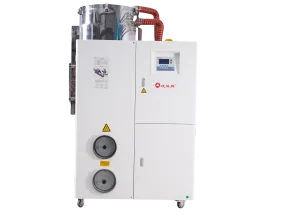 TCD Series
Energy-saving 3 in 1 system integrating heatless dehumidifying,…
TCD Series
Energy-saving 3 in 1 system integrating heatless dehumidifying,…
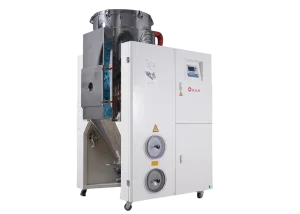 TCD Series
Integrated dehumidifying, drying and material conveying in one…
TCD Series
Integrated dehumidifying, drying and material conveying in one…
 TSH Series
Double-layer stainless-steel hopper dryer designed for uniform and…
TSH Series
Double-layer stainless-steel hopper dryer designed for uniform and…
Explore integrations
Related solutions
August 5, 2026
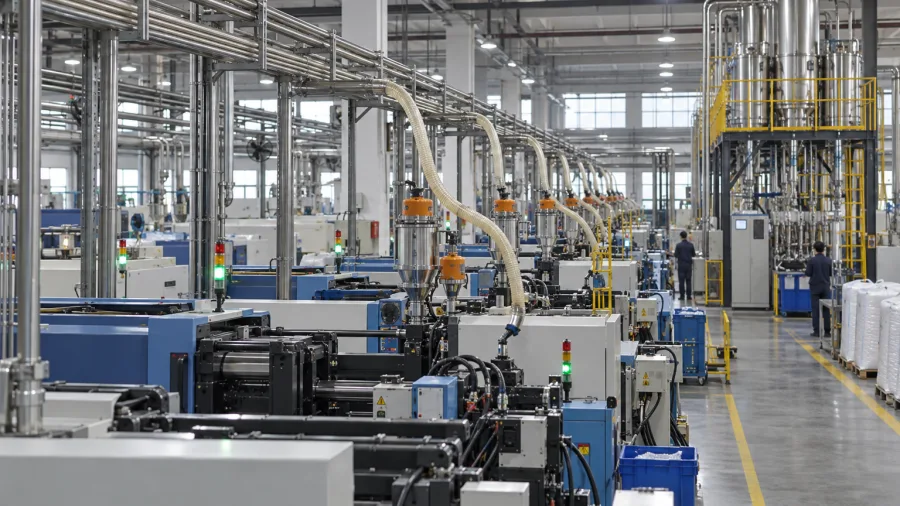
Central Feeding System for Multi-machine Production
Centralize storage, drying, conveying, distribution and monitoring to provide every processing machine with stable material supply.
Read article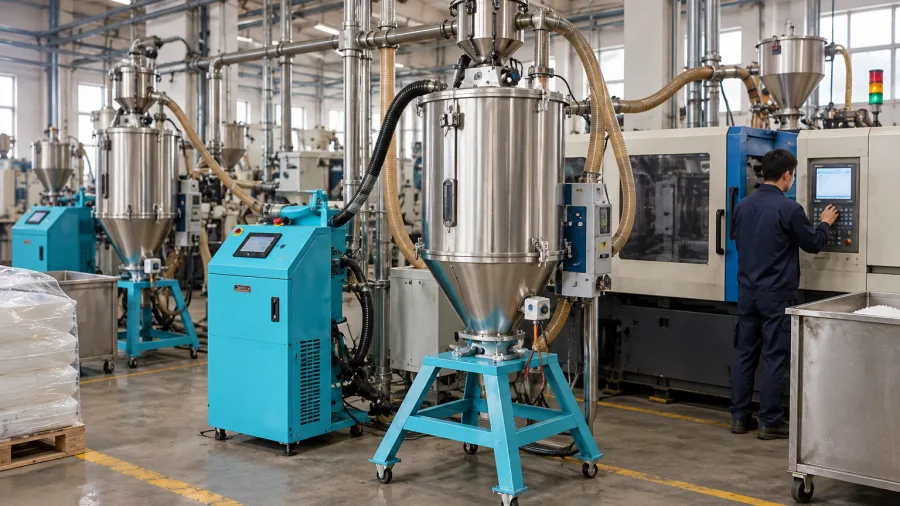
August 5, 2026
Drying & Dehumidifying
Maintain stable material conditions with low-dew-point drying for hygroscopic engineering plastics.
Read article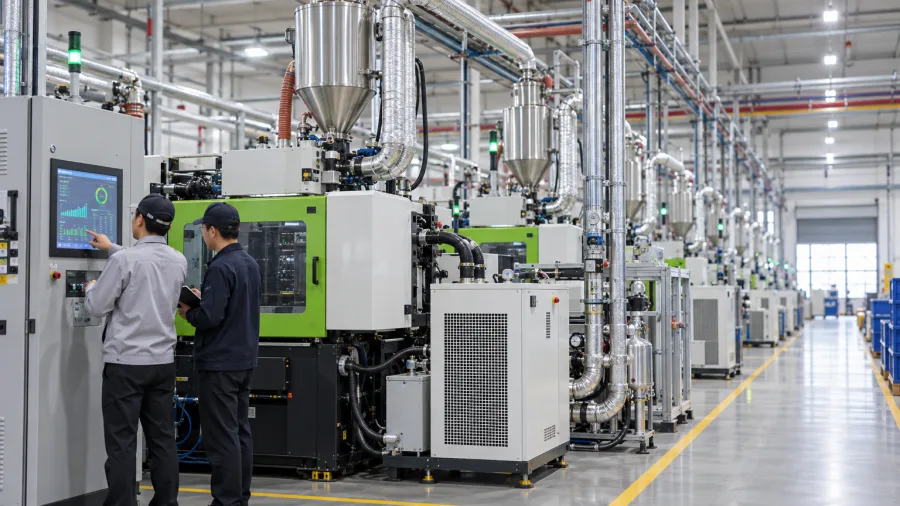
August 5, 2026
Energy-saving Retrofit
Upgrade existing equipment and controls to reduce power consumption and heat loss.
Read article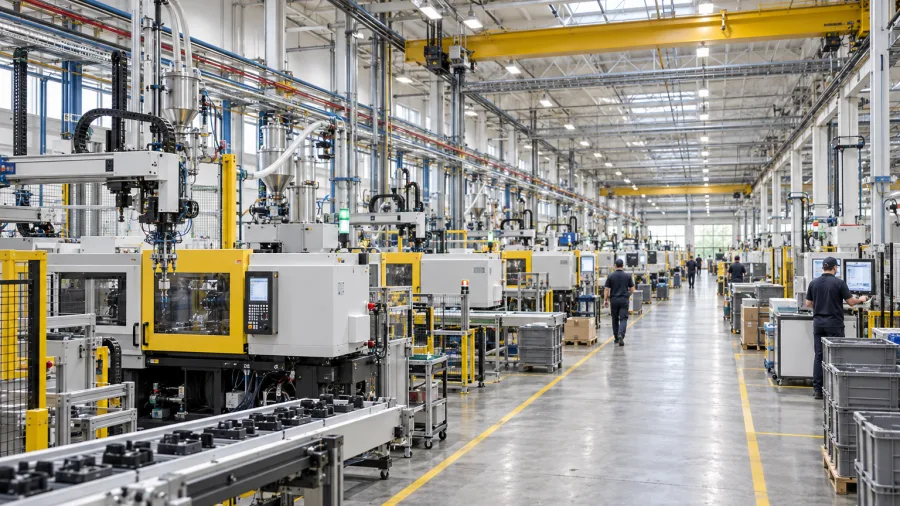
August 5, 2026
Plant-wide Automation
Connect feeding, drying, cooling and downstream processes with central control and production visibility.
Read article