
How Regrind Quality Changes Injection Molding Results
Particle size spread, fines, dust and thermal history all change how regrind melts. What to measure and which re-feed ratio actually holds.

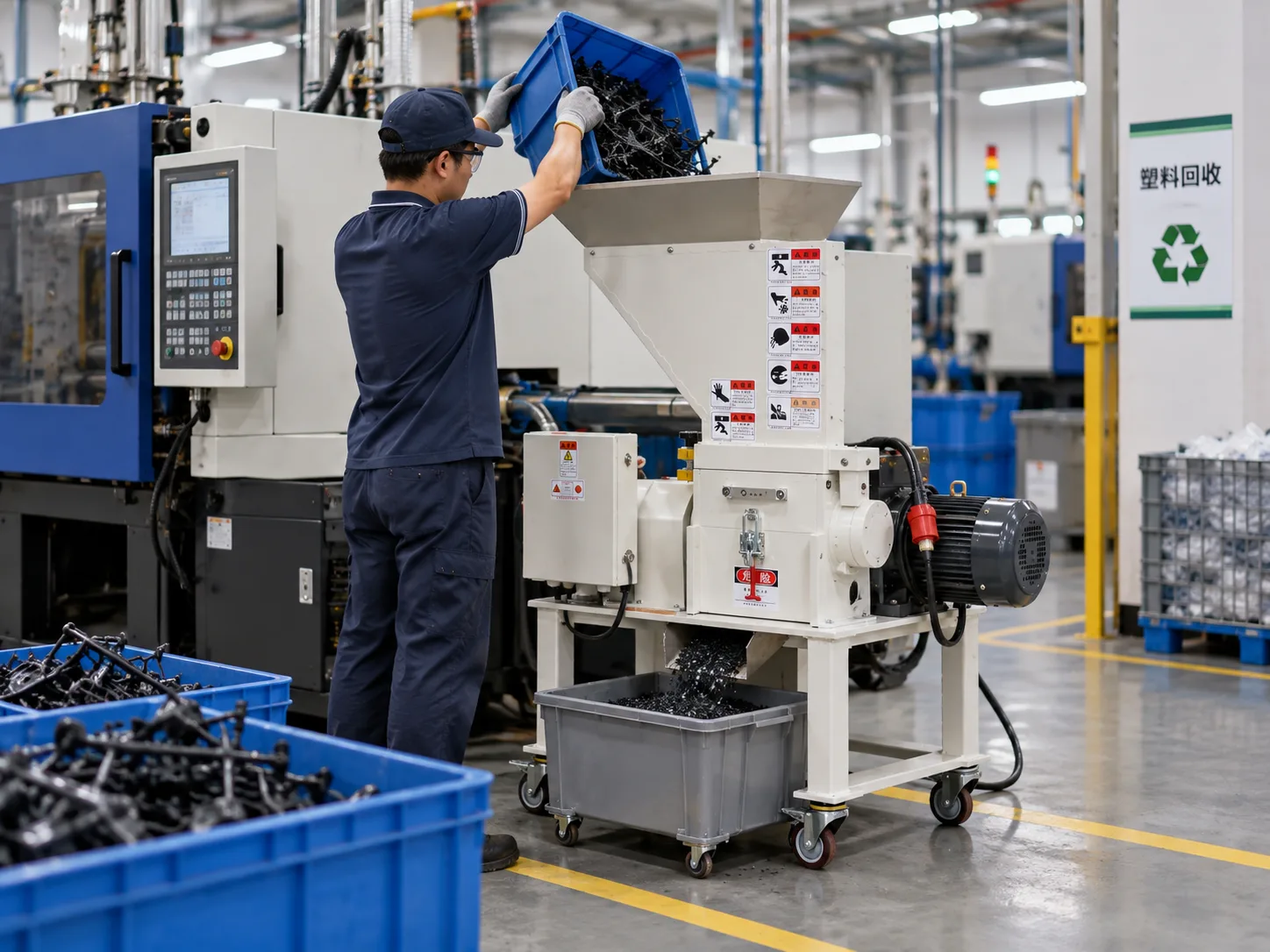
Regrind is not the same material as virgin granule, and treating it as such is the most common cause of intermittent molding defects. Three properties change when material is granulated: particle size distribution widens, fines content rises, and the polymer accumulates thermal history. Each one affects melting, feeding and final part properties in a different way.
The practical consequence is that a plant can run perfectly for weeks at 10 % regrind and fail at 25 %, with no change to any machine setting.
Why does particle size spread cause molding problems?
The screw melts material by shear and conduction, and both depend on particle size. Small particles melt first and can overheat while large particles are still solid, which produces unmelted specks and inconsistent melt temperature in the same shot.
Wide spread also causes segregation: fines settle to the bottom of a hopper while larger granule migrate upward, so the regrind ratio actually reaching the screw changes through the day even when the blend ratio at the hopper is fixed.
What does fines content actually do?
Fines behave differently in three places at once:
- Feeding — fines bridge in hoppers and stick to dryer walls, causing short shots that appear random.
- Drying — fines dry faster than granule, so a blend dried to specification has over-dried fines and under-dried granule.
- Melting — fines absorb heat quickly and can degrade at the screw, producing black specks and splay that looks like a moisture problem.
Fines above roughly 5 % of the blend are usually enough to cause intermittent defects. Screen size, rotor speed and blade condition all influence how much is produced.
How much thermal history does regrind accumulate?
Every pass through the machine adds thermal history, and every granulation adds mechanical stress. For most commodity resins the effect is small at moderate re-feed ratios. For engineering resins — particularly PA, PC and PBT — the second and third pass measurably reduces molecular weight.
| Resin | Typical safe re-feed | Watch for |
|---|---|---|
| PP, PE, PS | 20–30 % | colour shift, flow lines |
| ABS | 15–25 % | impact strength loss |
| PA, PBT | 10–20 % | IV / viscosity drop |
| PC | 10–15 % | yellowing, brittleness |
| PET | 0–10 % (grade dependent) | IV loss, acetaldehyde |
These are starting points, not rules. The actual limit depends on part requirements and on how many times the material has already been through the process.
How should regrind be dried and blended?
Regrind holds more moisture than virgin because of its surface area, so it needs either a longer cycle or a separate drying step. Blending wet regrind with dry virgin produces a blend whose average moisture looks acceptable while individual particles are not.
Two rules work in practice: dry regrind separately when the ratio is above about 15 %, and never assume the drying time for virgin applies unchanged.
What should a plant measure?
Four measurements catch most regrind problems before they reach the customer:
- Particle size distribution — a simple sieve check on a sample, done monthly.
- Fines content — weigh the fraction below 1 mm; above 5 % is a warning.
- Moisture on the blend — not on the virgin only.
- Part impact or tensile on the highest re-feed ratio — the number that actually limits the ratio.
Where to go next
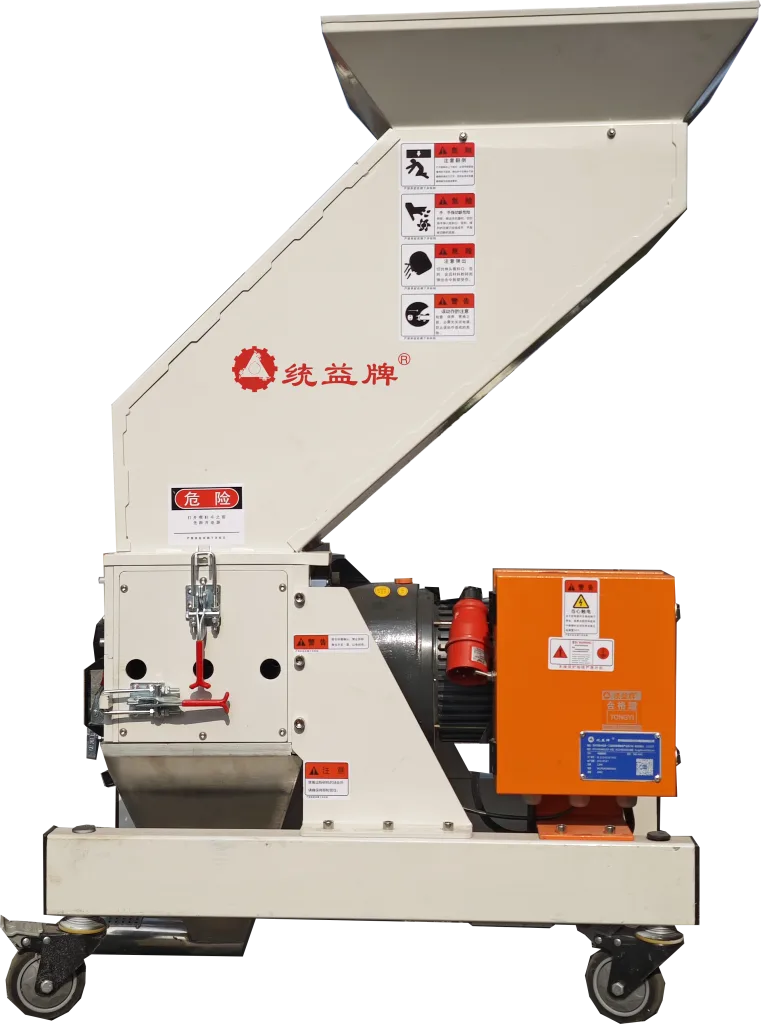
Regrind quality starts at the granulator. The low-speed side granulator produces the most uniform particle size for runner recycling, while the powerful granulator is intended for thick scrap where size reduction comes first and particle uniformity second.
If you are seeing intermittent splay or black specks at higher re-feed ratios, send us the granulator settings and regrind ratio and our engineers will help narrow down the cause.